
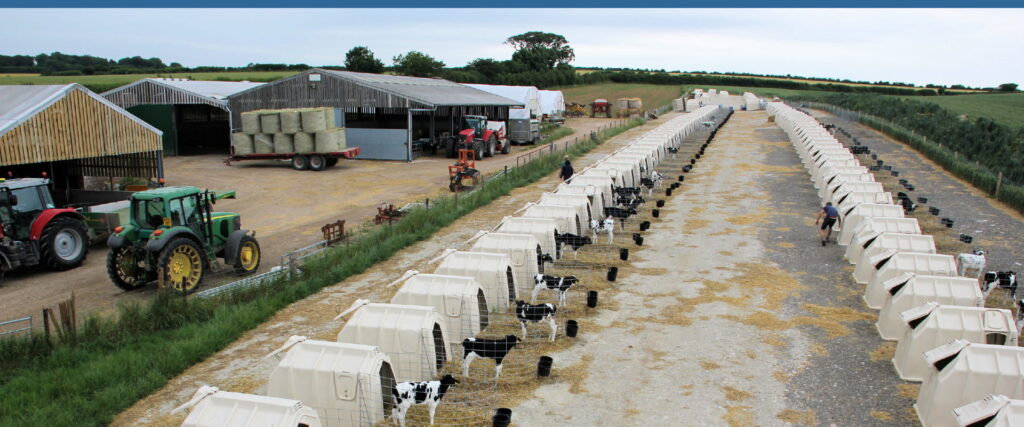
Choosing the right calf housing is not only a practical decision. It also affects welfare standards and regulatory compliance. For UK farms, calf hutches and housing systems must meet specific welfare requirements that govern space, social contact, hygiene, and calf development.
For farmers, compliance affects day-to-day management and assurance scheme performance. For suppliers, it affects how housing systems are designed, specified, and installed. The challenge is not simply meeting the rules on paper. The housing also needs to remain practical to clean, feed, inspect, and manage efficiently.
This is why calf hutch compliance should be considered early when selecting or upgrading calf housing systems.
Understanding UK calf housing regulations
UK calf welfare legislation sets minimum standards for calf accommodation. These rules apply across individual hutches, group housing systems, and internal calf pens.
In practical terms, the regulations require that:
- calves cannot be kept in individual pens or hutches after eight weeks of age unless a veterinary surgeon confirms isolation is necessary,
- individual calf housing must allow calves to see and touch other calves where required,
- housing dimensions must suit the size of the calf rather than relying on a standard hutch size,
- group-housed calves must have minimum floor space allowances based on liveweight,
- every calf must be able to stand up, lie down, turn around, rest comfortably, and groom itself naturally.
The regulations are designed to support both physical health and behavioural welfare. They also align closely with farm assurance expectations and inspection criteria.
What calf hutch compliance means in practice
Compliance is the result of several design decisions working together.
For example, hutch size must account for calf growth over time. A system that works for young calves may become unsuitable as animals gain weight or approach the eight-week threshold. This is one reason why flexible housing layouts are increasingly important on modern farms.
Paired hutches and linked systems can help farms transition calves into social housing more smoothly while supporting welfare requirements around contact and interaction. Fence layout and partition design also matter. Solid separation may reduce contact beyond what welfare guidance intends, while poorly designed access arrangements can make feeding and inspection more difficult.
Feed-door positioning is another practical consideration. Housing should support efficient feeding routines without increasing contamination risks or creating unnecessary labour.
Ventilation and drainage also play a major role. Compliance is not only about floor area. Poor airflow, damp bedding, or ineffective cleaning access can quickly undermine calf health even where dimensional requirements are technically met.
Well-designed calf housing should therefore support:
- compliant stocking densities,
- effective hygiene management,
- easy feeding access,
- safe calf handling,
- airflow and drainage performance,
- flexible use across different calf ages and weights.
Common calf housing compliance mistakes
Many compliance problems develop gradually rather than through obvious neglect. Small management decisions can create welfare issues over time.
One common issue is keeping calves in individual hutches for too long. As calves grow, housing that was initially suitable may no longer meet welfare requirements.
Another frequent problem is overlooking tactile contact requirements. Visual contact alone may not always satisfy welfare expectations depending on the housing configuration.
Space allowances are also often underestimated. Compliance calculations should consider the actual size and development stage of the calf, not simply the nominal capacity of the housing unit.
Some farms also assume that one housing setup can accommodate all calf ages. In reality, calf requirements change significantly as animals grow. Housing systems should reflect that progression.
Other issues include:
- inadequate drainage around hutches,
- poor cleaning access,
- restricted airflow,
- overcrowding in group pens,
- insufficient flexibility for changing herd requirements.
These problems can increase disease pressure, reduce calf performance, and create unnecessary challenges during inspections.
How the right calf housing system helps
The most effective calf housing systems are designed around both welfare compliance and operational efficiency.
Good housing design can help simplify inspections, improve hygiene standards, reduce disease transmission risks, and support more consistent calf growth. It can also reduce labour pressure by improving feeding access, cleaning routines, and stock management.
For suppliers, this means housing systems should not only meet technical requirements but also work effectively in real farm conditions.
Intershape calf housing systems are designed to support practical compliance through durable construction, effective layouts, and flexible housing configurations that align with current welfare expectations. The objective is straightforward: help farms maintain compliant calf accommodation without making day-to-day management harder.
As welfare standards continue to evolve, housing design will remain a critical part of calf management strategy. Farms that plan housing around both compliance and usability are typically better positioned for herd performance, assurance standards, and long-term operational efficiency.
For more information on compliant calf housing solutions, contact Intershape or review the company’s calf housing compliance guidance document.
How Intershape Can Help
We supply a range of high-quality livestock housing products to dairy and beef farmers across the UK. Our cubicles and feed fences, mats and mattresses, and ancillary housing equipment are competitively priced and backed by practical advice from a team with real farming knowledge.
Whether you need to replace a worn feed fence ahead of turnout, upgrade your passage matting before the spring flush, or plan a more comprehensive housing improvement project, we are here to help. As a family business based in Northamptonshire with over 30 years’ experience, we understand the pressures of spring and the importance of getting your infrastructure right before the season begins.
Browse our livestock range at www.intershape.com or call our team on 01327 300 395 for friendly, practical advice.
Key Takeaways
- UK calf housing regulations are based on calf welfare and behavioural needs, not just minimum dimensions.
- Individual calf hutches cannot normally be used beyond eight weeks of age without veterinary justification.
- Housing systems must provide enough space for calves to stand, lie down, turn around, and interact naturally.
- Compliance depends on practical design factors such as hutch size, layout, ventilation, drainage, and social contact.
- Well-designed calf housing can support compliance while also improving hygiene, labour efficiency, and calf management.